Who Is Teaching Your Child? The Responsibility of Parents to Recognize Biblical Truth and False Teaching

As parents, we make important decisions about who will care for, educate, influence, and teach our children. We carefully consider their safety, academic development, social experiences, and emotional well-being. But have we given the same attention to the spiritual influence of those entrusted with teaching them? There is a responsibility that cannot be transferred to a school, childcare provider, teacher, curriculum, or community program: the responsibility to guide our children in God's truth.
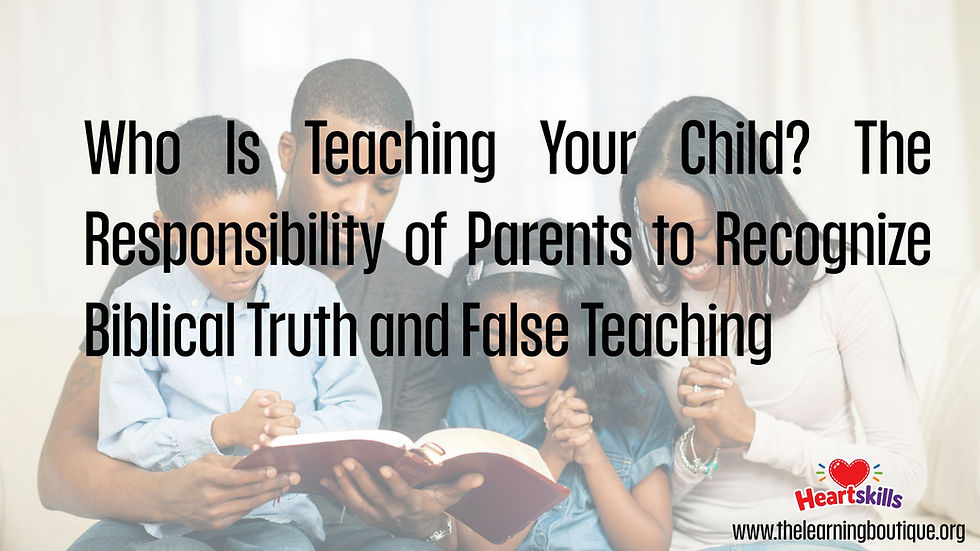
What is influencing your child's understanding of right and wrong?
In Deuteronomy 6:6–9 (NIV),
These commandments that I give you today are to be on your hearts. Impress them on your children. Talk about them when you sit at home and when you walk along the road, when you lie down and when you get up. Tie them as symbols on your hands and bind them on your foreheads. Write them on the doorframes of your houses and on your gates.
God instructs His people to keep His commandments in their hearts and impress them on their children, speaking about them throughout everyday life. Notice that teaching God's Word is not presented as an occasional activity. It is part of everyday living. Children are learning more than letters, numbers, sharing, taking turns, and how to express themselves. They are also developing an understanding of what is right, what is wrong, what is acceptable, and what they should value. When the people teaching our children consistently present ideas that contradict God's Word, we cannot assume those lessons are harmless simply because they are delivered in a classroom, childcare center, homeschool resource, or community program. Not every teacher will share our faith. However, parents must recognize when something being taught conflicts with biblical truth rather than assuming that every educational practice or philosophy is morally neutral.
Jesus warns us in Matthew 7:15–20 (NIV) to watch out for false prophets and teaches that we recognize them by their fruit.
“Watch out for false prophets. They come to you in sheep’s clothing, but inwardly they are ferocious wolves. By their fruit you will recognize them. Do people pick grapes from thornbushes, or figs from thistles? Likewise, every good tree bears good fruit, but a bad tree bears bad fruit. A good tree cannot bear bad fruit, and a bad tree cannot bear good fruit. Every tree that does not bear good fruit is cut down and thrown into the fire. Thus, by their fruit you will recognize them."
This gives us an important principle: we must pay attention to what is being produced by someone's influence. Look for the fruit, not just the words.
Watch the Companion Reel: Moxie Learnns About the fruit of The Spirit: Kindness
In the video Moxie shares how her teacher words do not match her actions
Galatians 5:22–23 (NIV) describes the fruit of the Spirit: love, joy, peace, forbearance, kindness, goodness, faithfulness, gentleness, and self-control.

When considering someone entrusted with teaching your child, ask yourself:
• Does this person demonstrate patience and kindness, especially when a child makes a mistake?
• Do they correct children with gentleness rather than humiliation?
• Do they demonstrate self-control when frustrated?
• Do they encourage honesty, goodness, and responsibility?
• Do they model humility and a willingness to acknowledge when they are wrong?
• Do their actions reflect the values they claim to teach?
We must remember that no teacher is perfect. The fruit of the Spirit is not a demand for perfection. It is an examination of the character and direction of someone's life.
A teacher's words matter, but their example matters too.
Parents, Do Not Surrender Your Responsibility
It is not enough to ask whether your child enjoys school, whether the teacher is friendly, or whether the curriculum produces academic progress. Ask what your child is learning about truth, relationships, responsibility, obedience, forgiveness, and the difference between what feels right and what God says is right. Read the curriculum. Ask questions. Have conversations with your child. Compare what is being taught with Scripture. Do not be afraid to address practices or lessons that contradict God's Word.
Fathers, do not exasperate your children; instead, bring them up in the training and instruction of the Lord.
Ephesians 6:4 reminds parents of their responsibility to bring children up in the training and instruction of the Lord. That responsibility belongs to parents even when others assist with education and care.
A Call to Action for Parents
Do not become passive participants in your child's education. Become intentional about who is influencing your child. Look beyond credentials, popularity, reputation, and educational achievements. Examine character, teaching, and fruit. Most importantly, become a living example of the truth you want your children to learn. We cannot expect children to recognize biblical truth if we are unwilling to read God's Word, apply it, and demonstrate it in our own daily lives. Our children need more than people who teach them what to do. They need adults who demonstrate what it looks like to live according to God's truth.
The question is not simply, “Who is teaching my child?” It is also, “What are they teaching my child to believe, and what kind of fruit is their influence producing?”


Comments